Showing posts with label Michelin. Show all posts

Providence (Los Angeles)

It was admittedly disappointing that our table at Providence wasn’t ready at the reserved time, something you expect can happen at restaurants, but usually not at a three-Michelin-star establishment. Instead, we were seated in the bar area with menus and water while we waited. Ten minutes later, we were finally brought to our table. Maybe it’s simply California time, because for a major city, people in Los Angeles are awfully relaxed. Eventually, I embraced the slower pace with a glass of champagne. Bubbles make almost anything better.

Providence offers two tasting menus: the classic ($375 for 8 courses) or the chef ($495 for 10 courses). Interestingly, the menus are largely the same. With the classic, diners choose one of three mains, including paying an additional $45 supplement for the wagyu. The chef’s menu includes all three mains and folds the supplement into the price. There are also numerous supplemental dishes available, but the chef’s menu already felt like more than enough.

That’s especially true once the amuse-bouches begin arriving. A trio of tarts kicks off the meal, each using the same delicate shell in different ways. First comes bluefin tuna topped with caviar and sprayed tableside with basil vinegar that instantly perfumes the air. Then a creamy uni tart decorated with edible flowers and microgreens from Providence’s rooftop garden. Finally, a crispy roll filled with crème fraîche and wrapped in salmon. Elegant but playful all at once.

Additional bites continue the Americana theme, including a grilled cheese that takes truffle and sandwiches it between impossibly thin toasted bread. I may never look at grilled cheese the same way again.

A bite-sized taco follows, filled with wagyu and smoked oyster tartare. Despite its delicate appearance, it delivers an incredible amount of richness and flavour.

The official tasting menu begins with kaluga caviar paired with slices of geoduck and a country ham broth. We’re instructed to eat about two-thirds of the dish before adding more broth and shooting the remainder directly from the shell. The geoduck is wonderfully fresh and meaty, elevated by the caviar and bright tomato broth. A layer of silky tofu hidden underneath ties everything together and lends creaminess without relying on dairy. The final “shot” shifts the dish into a more savoury, almost comforting finish.

Before the next course, another off-menu surprise arrives - a miniature lobster roll featuring lobster tartare tucked into thick toasted milk bread and shaved Italian truffle. Delicious, though the lobster itself becomes somewhat overshadowed by the richer additions.

Their sashimi course showcased dry-aged wild cod surrounded by crème fraîche, nori oil, and hibiscus salt. Bite by bite, the fish felt delicate and spring-like, especially swirled through the airy sauce. Still, the final bite, layered with pickled ginger and extra flowers, ended up being the most memorable.

Pressure-cooked abalone followed, incredibly tender yet still satisfyingly meaty beneath a lightly sweet glaze. While I could have done without the puffed rice scattered overtop, I understood the textural contrast they were aiming for. Providence then doubled down on luxury by bringing over a box of spring white truffles and shaving them generously over the dish, which paired beautifully with the thick egg yolk sauce underneath.

Still, I found myself brushing aside the truffles just to admire the largest asparagus spear I’d ever seen. Had the menu not explained it came from Roscoe Zuckerman’s third-generation farm, I might have assumed it was genetically engineered. Somehow, the asparagus tasted almost juicy.

The patty pan squash tortellini arrived plump and surrounded by chunks of crab and uni. Individually, every element was excellent but once combined with the broth and fennel-basil oil, the dish truly came alive. The sweetness of the seafood balanced the broth beautifully.

Anyone worried about leaving hungry can relax once an entire boule of red fife sourdough arrives warm from the oven alongside cultured butter and sea salt. I’d heard about the revival of this heritage grain before but hadn’t realized its California roots. The bread itself had a hearty nuttiness while remaining fluffy and light.

When the black bass arrived and the server described it as “kinki fish” from Japan, I momentarily thought he said “kinky fish,” which certainly grabbed my attention. The fish itself was delicate yet rich, almost like a lighter but fattier version of black cod. Still, the sweet spring peas nearly stole the show.

The menu then transitions into the trio of mains. Ordinarily, I probably wouldn’t have selected the California king salmon, which would have been a shame because the dish came with a story. Due to years of drought, the salmon hadn’t appeared on menus for four years since there wasn’t enough water for migration upstream.

Providence prepares the salmon by sandwiching it between thin milk bread before searing it, allowing the bread to soak up the beurre blanc and herb oil. Paired with porcini mushrooms and grilled ramps, the dish had that coastal feel.

Had I been choosing independently, I likely would have gravitated toward the Liberty Farms duck from Napa Valley. Before serving, the kitchen presents the entire bird tableside in a theatrical “show-and-tell” moment before carving it into beautifully tender slices.

While the duck itself was excellent, the salted cherry sauce wasn’t entirely to my taste. I did, however, love the whimsical “faux” foie gras cherry accompanying the dish, silky and visually stunning enough to make you forget about the real thing entirely.

The final savoury course was A5 wagyu, so intensely rich that after a few bites my palate was completely overwhelmed with buttery fat. As though that weren’t decadent enough, it arrived alongside a morel stuffed with sweetbread, turning the mushroom into a rich protein of its own. By this point in the meal, it was simply too much for me personally.

Before dessert, a cheese cart appears tableside. Completely stuffed, I opted out, though my friend didn’t. Frankly, the restaurant should warn diners that the cheese service ($70) is large enough for a table. Two long slices of 30-month-aged Jura Comté topped with generous summer truffles and rooftop honey arrived first, surprisingly light due to how thinly the cheese was sliced.

The truffle brie, meanwhile, was far richer and funkier than expected, almost approaching blue cheese territory. Providence creates it by splitting a wheel of brie, stuffing it with black truffles, then coating the outside with chopped truffle “frosting.” Truffle lovers would probably lose their minds over it.

Thankfully, the next course was a refreshing red fruit sorbet that acted as the palate cleanser I desperately needed. The combination of berries, shiso, and makrut lime struck a beautiful balance between sweet and citrusy. Shaping it like a Michelin star was a cheeky touch, though I joked they should have served three of them.

One thing that truly sets fine dining apart is the obsessive dedication behind the scenes. During COVID, Providence pastry chef Mac Daniel Dimla apparently spent his downtime learning chocolate making. He now produces chocolate in-house and dessert becomes a showcase for that passion.

The first dessert, using Hawaiian Mauna Kea cacao, resembled a delicate cake layered with thick mousse and a silky ganache disk, paired with a salty Venetian sauce and another tart accompaniment. Individually, the flavours felt bold and distinct, but together they combined beautifully.

Among the petit fours, my favourite was easily the blueberry verbena tart, which cleverly echoed the tart amuse-bouches from the beginning of the meal. There was, naturally, even more chocolate in the form of a Mexican chocolate macaron and a truffle filled with crunchy pistachio centre. The cone-shaped bite, meanwhile, leaned heavily into sesame and citrus flavours that felt more acquired in taste.

What truly fascinated me, however, was the chocolate mint tea. It smells unmistakably like chocolate but drinks like herbal tea. Alongside it came what looked like honey but turned out to be a syrup made from cocoa husks, it’s an example of Chef Dimla’s low-waste philosophy.

Ultimately, Providence feels distinctly Californian. The menu leans heavily into seafood and seasonality without ever becoming overly stiff. There are playful touches everywhere, from animal-shaped zodiac knife rests to rooftop gardens, house-made honey, and in-house chocolate production. And just when you think the experience is over, they send you home with a small bar of Peruvian chocolate as one final reminder of the evening.

Providence somehow balances luxury with personality. One moment you’re eating caviar and white truffles, the next you’re laughing about zodiac knife rests and “kinky fish.” It’s polished fine dining that still knows how to have fun.

Overall mark - 8 out of 10


How To Find Them
 Location: Los Angeles, USA
 Address: 5955 Melrose Avenue


Follow me on twitter to chat, be notified about new posts and more - https://twitter.com/GastroWorldBlog
____________________________
Gastro World's Grading System

  • Anything under 5 - I really disliked and will never go back
  • 6 - decent restaurant but I likely won't return
  • 7 - decent restaurant and I will likely return
  • 8 - great restaurant that I'd be happy to recommend
  • 9 - fantastic restaurant that I would love to visit regularly and highly recommend
  • 10 - absolute perfection!


Is That It? I Want More!

Other Gastro World posts similar to this:


Osteria Giulia (Toronto)


While Osteria Giulia has been awarded a Michelin star, it’s unlikely they’ll receive a service award anytime soon. Having arrived five minutes early, they weren’t ready to seat tables and we were asked to leave – no option to wait inside or at the bar, what a pain during a windy cold fall evening. Nonetheless, once we were seated, our waitress was warm and welcoming, making up for the poor first impression from the hostess.

Luckily, the food didn’t disappoint. The burrata e caviale ($45), although served a bit cold for my taste, was soft and fluffy, the centre creamy but doesn’t ooze out upon being cut through. The simple starter was a cacophony of flavours mixing briny Italian caviar, sweet Asfodelo honey, and a smoky sourness from the Blackbird bread. That splash of sweetness from the honey was unexpected but absolutely made the dish.

Pull apart the calamari ripieni con tonno ($36) before taking a bite and you’ll find the delicate seafood stuffed with yellowfin tuna paste so there’s a meatiness to each bite. It’s topped with a puntarella and charred pepper salad, giving the calamari a refreshing crispy bite. I’m glad it wasn’t overloaded with too many sauces so that the natural seafood flavours were present.

In retrospect, the lorighittas al mare ($38) was too similar to the calamari. In fact, when the dish was presented, all I could see was a plate of squid rings, only to find many were circles of hand braided pasta. Our waitress explains what makes the dish special is the time intensive nature of creating the pasta, which did have a lovely bite to it. Everything is tossed in a tasty olive oil sauce with a hint of garlic, chilli, and an umami essence from anchovy. I just wish the dish had more of the bay scallops and even some spot prawns thrown in to make it taste more like a seafood pasta.

I’m generally hesitant to order ravioli as it’s usually a scant dish and when they are not adequately filled it can taste like you’re eating pieces of dough. Osteria Giulia’s ravioli doppi ($44) smartly has one side unsealed so they can be overstuffed with silky ricotta and sauce, so you get a gush of filling with each bite. Chunks of lobster and kernels of sweet corn add richness and texture to the dish. It was an impressive dish and the most memorable of the evening.

If you’re visiting the restaurant and expecting to be full after an appetizer and pasta, you’ll be disappointed. Following true Italian traditions, the pasta is just the second course, you’ll need to order a main. We shared the rack of lamb for two ($85) and were presented with eight perfect medium rare lamb chops that were lightly dusted with sea salt. While this would be even better if it was served with a sauce, to give it interest, the meat was prepared beautifully.

The fagioli ($16) went particularly well with the lamb, the crispy beans well coated with a salty spicy meat sauce that added a punch of flavour against the otherwise neutral lamb.

With a selection of delicious sounding desserts, I opted for the millefoglie al cocco ($19), which was beautiful to take in with the thin layers of crispy pastry separating dollops of white chocolate and mango cream. It’s a dessert that could have benefited from being served with a knife, as it was difficult to break through the puff pastry.

Every table needs to order the tiramisu alla Giulia ($19), a rendition of tiramisu that brings it to another level with the ice cream centre and huge dollop of mascarpone and rum zabaglione on top. It was so rich and delicious… how can I have tiramisu any other way?

Osteria Giulia gets mixed reviews online and I can see why: what you order and how much you order can really affect the experience. While it’s a great Michelin option for those who have a smaller appetite or want the flexibility of controlling a budget for the evening, the restaurant should consider making a tasting menu to ensure tables get to really experience all their “best of” dishes – the ravioli, burrata, and tiramisu.  

The restaurant is certainly one of the more inventive Italian restaurants I’ve visited in Toronto and offers some impressive dishes. Still, there’s something about the experience that’s lacking compared to other Michelin restaurants in the city such as the absence of well-rounded service, not serving fully presented mains, and employing annoying nickel-and-diming practices like charging $3 a person for water. Unlike their ravioli, it’s not one experience I’ll be gushing about. 

Overall mark - 8 out of 10


How To Find Them
 Location: Toronto, Canada
 Address: 134 Avenue Road


Follow me on twitter to chat, be notified about new posts and more - https://twitter.com/GastroWorldBlog
____________________________
Gastro World's Grading System

  • Anything under 5 - I really disliked and will never go back
  • 6 - decent restaurant but I likely won't return
  • 7 - decent restaurant and I will likely return
  • 8 - great restaurant that I'd be happy to recommend
  • 9 - fantastic restaurant that I would love to visit regularly and highly recommend
  • 10 - absolute perfection!


Is That It? I Want More!

Other Gastro World posts similar to this:


Kaiseki Yu-Zen Hashimoto Restaurant (Toronto)

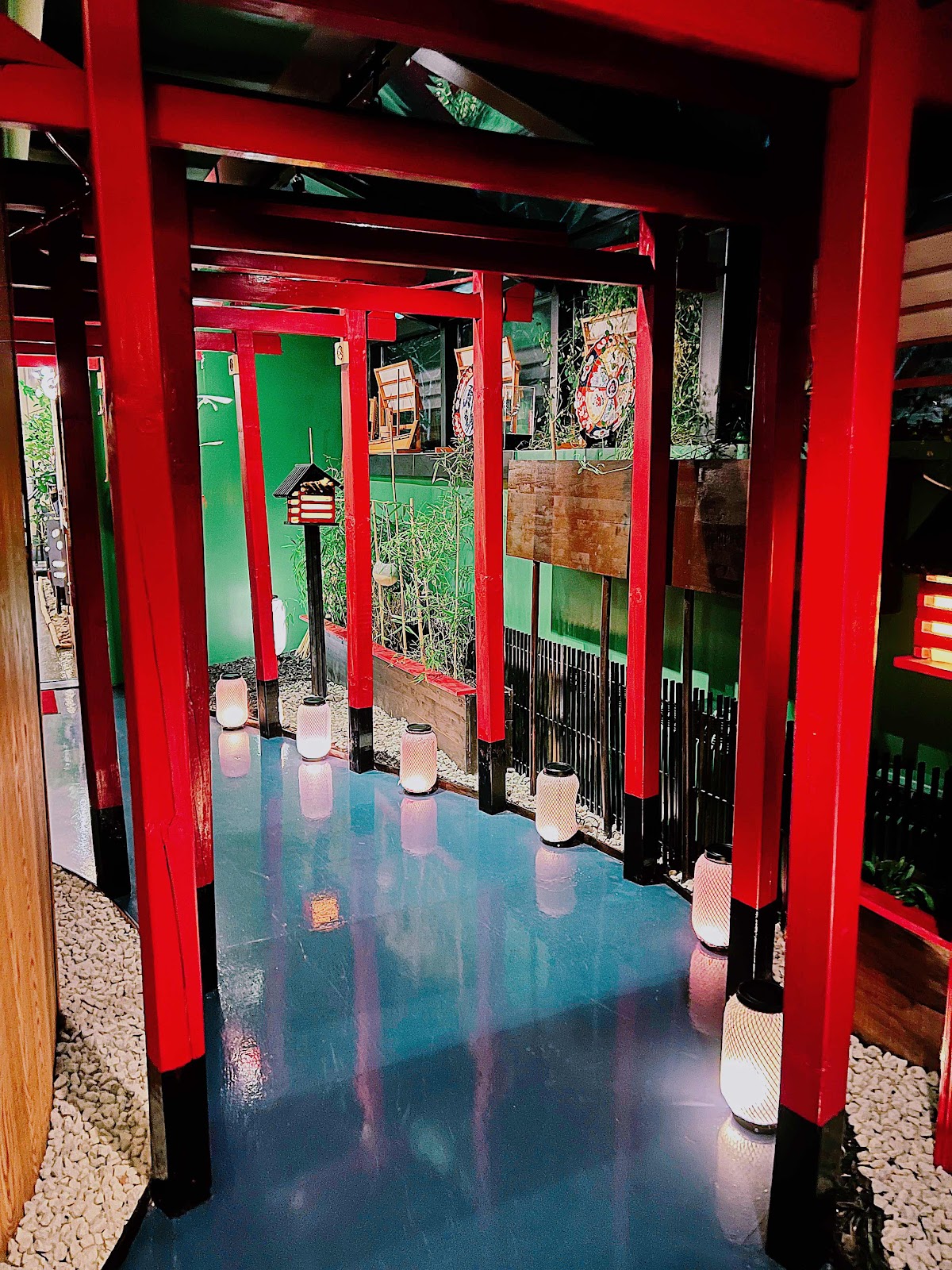
Tucked in the Japanese Cultural Centre, walking into Kaiseki Yu-Zen Hashimoto transports you to another country. Given their limited seating, their doors may be locked, so give the posted number a call and in no time, someone will greet you at the entrance and lead you through the orange torii gates into the dining room.

There’s so much to take in that the first ten minutes is like sensory overload. Take a deep breath and get ready for the meal; Hashimoto only serves three tables an evening, there’s plenty of time to explore after dinner. So, settle into your private dining room and decompress for the meal to come.   

Hashimoto describes kaiseki as “much of an art form as a style of food preparation” and this is certainly accurate. Each dish was beautiful and like a gift waiting to be unwrapped; a sense of excitement settled over me as I lifted the dome from many of the courses.

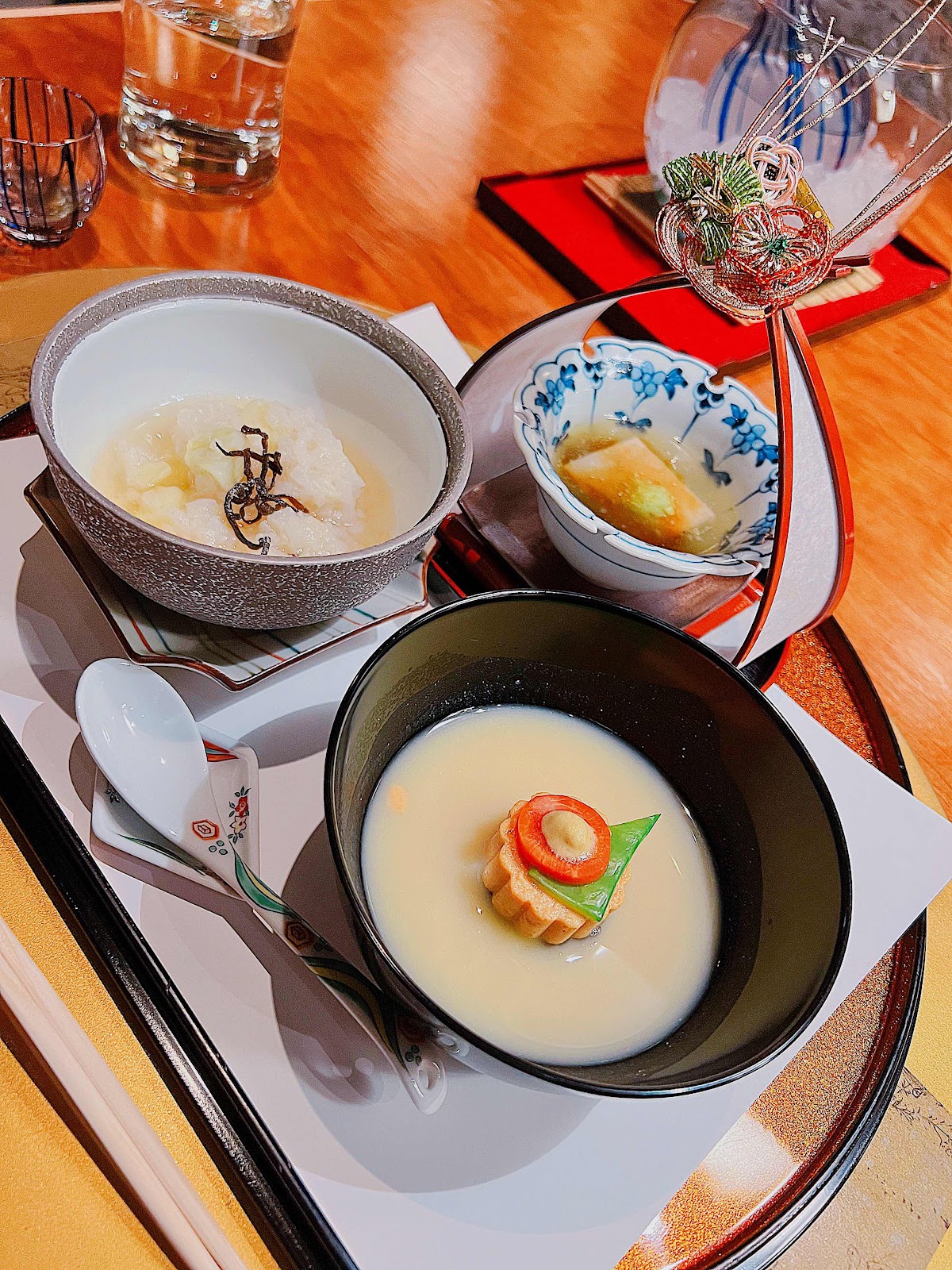
The eight-course meal ($350 per person) began with an onjyaku-zen (amuse bouche) consisting of three hearty soups designed to warm-up the stomach. Hashimoto’s saikyo miso soup wasn’t overly salty but rather rich in umami made with white miso, topped with a braised carrot, and a pea-sized amount of mustard to add an expected spice against the broth. Meanwhile, the nutty flavour that burst through the cube of goma (sesame) tofu was incredible, almost bordering bitter if it weren’t balanced out by the thick savoury soup. If anything, I could have done without wasabi on the tofu as the sesame taste was already so pungent.

Of all three bowls, my favourite was also the simplest and what Hashimoto calls “seasoned rice”. It’s like a thick congee studded with cubes of sweet soft squash and topped with slivers of salty dried kelp (?). The bowl was lovely and comforting and had us wanting another taste of it to end the meal.

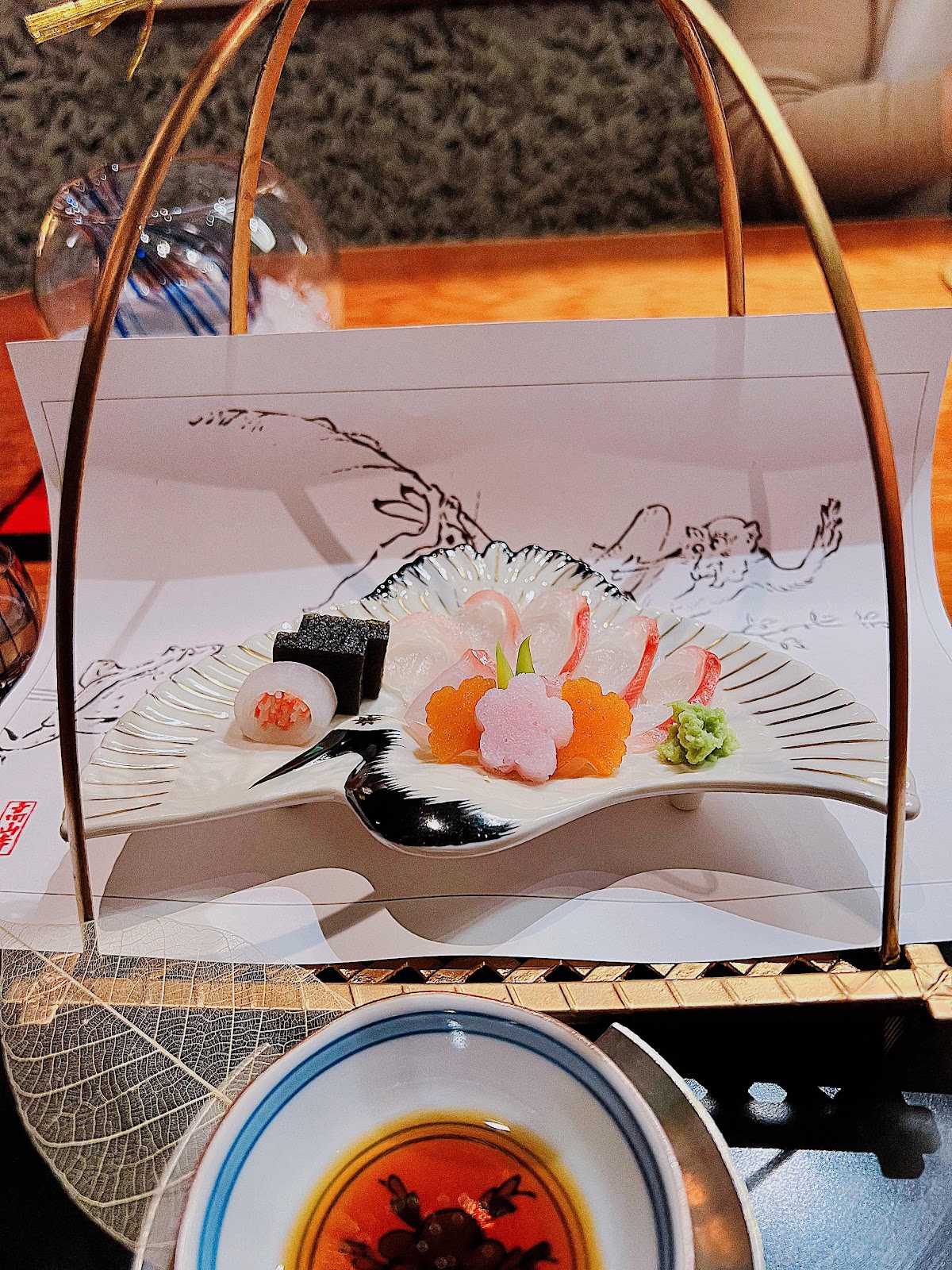
Paper thin slices of tennen madai (line caught sea bream) was featured in the sashimi course, so delicate that it’s like eating flower petals made of fish. Around the plate were three agar jellies flavoured with ginger, carrot, and seaweed, as well as a washer-sized daikon filled with thinly julienned pickled vegetables. It’s a much lighter dish following the onjyaku-zen and really showcases the knife skills of Chef Masaki Hashimoto.

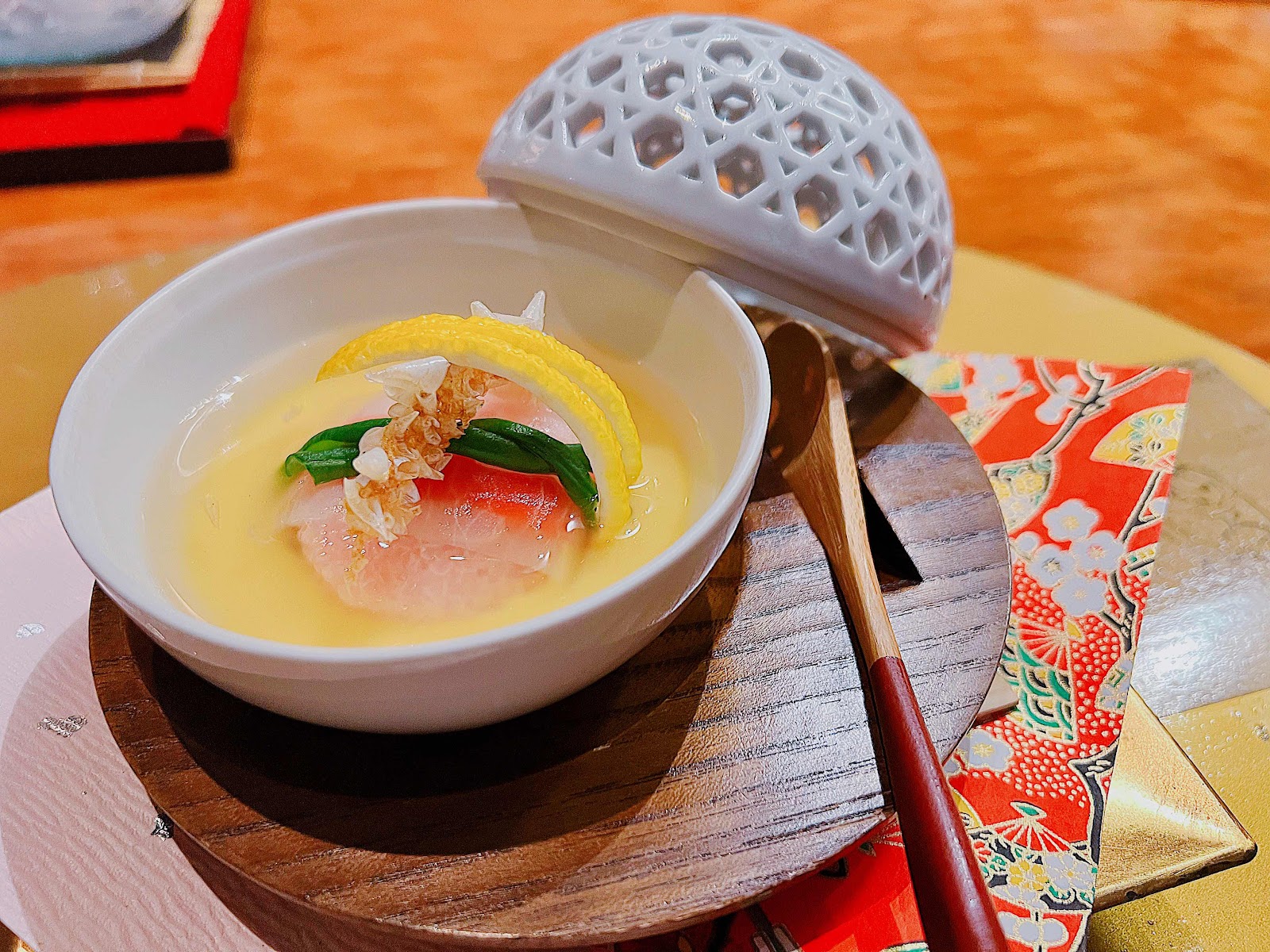
Diners are asked to refrain from wearing strong scents to ensure they’re able to enjoy the sensory experience of the food. The yuzu aroma that escapes from the owan-mono was so refreshing, although at first whiff, it leaves me wondering if a citrusy soup is something I’d enjoy.

Hashimoto didn’t disappoint, balancing the yuzu in a savoury consommé and pairing it with a host of rich flavours: a silky chawanmushi (egg custard), a thick chewy rice cake, and a soft braised daikon. The slice of amadai (tile fish) was cooked perfectly and I loved that the fish’s scales were deep fried to form a crunchy garnish on top.

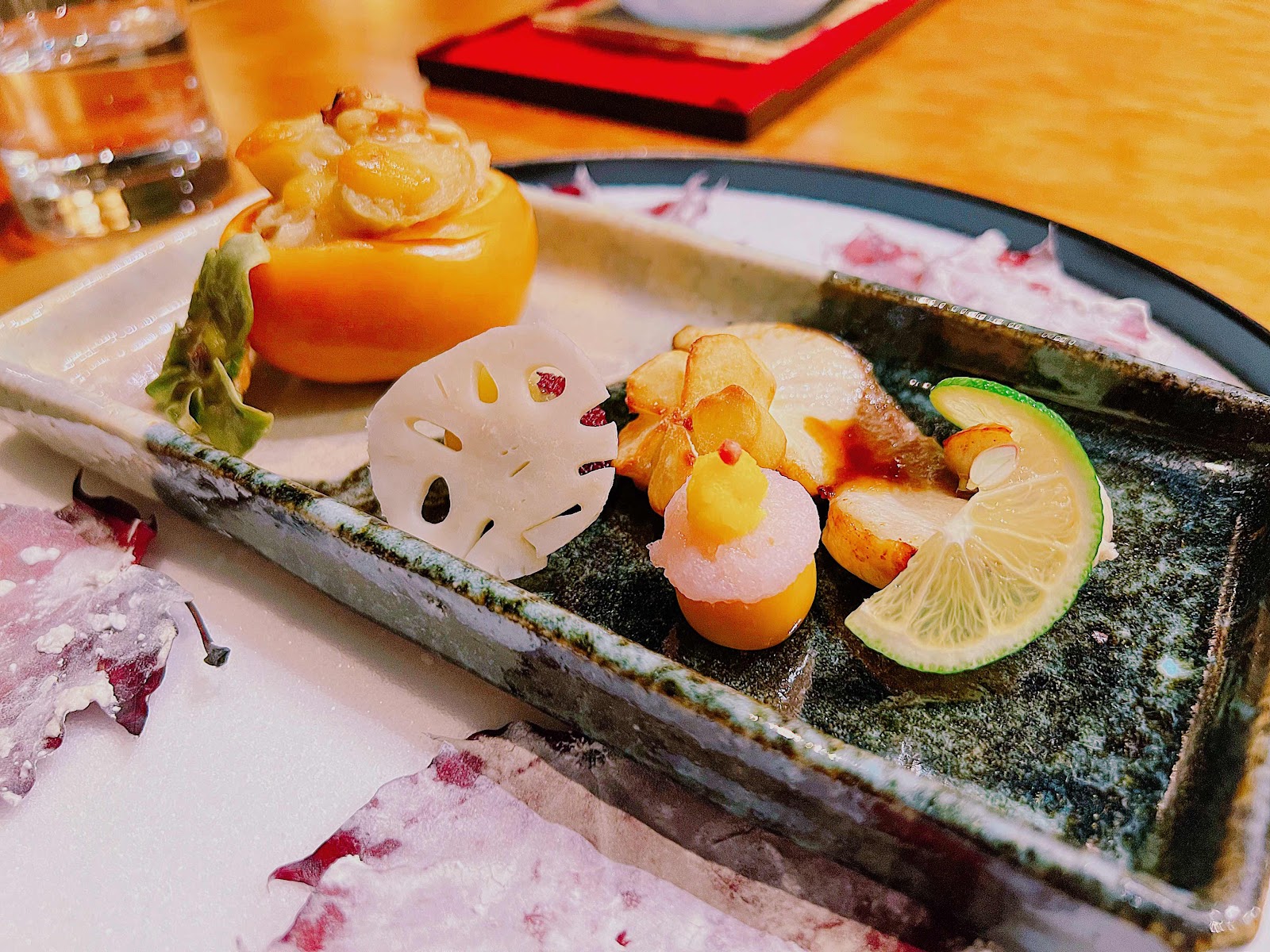
The yaki-mono (grilled course) featured a host of ingredients that were in-season during the autumn in Japan. Generally, I only have persimmons raw, yet somehow the fruit tastes so good baked, releasing more of its sweet flavours with chewy pieces of mochi included to soak up some of its juices. The fruit was so inventive that the grilled shima-aji (stripe jack) almost seemed secondary; I found the fish a tad overcooked and in need of a stronger glaze to make it stand out.

To finish the yaki-mono a host of seasonal produce were used as palette cleansers including crisp lotus root, a gooseberry topped with egg yolk (surprisingly, it works), mountain yam, and a lovely mountain peach that’s almost tastes like a cross between a plum and strawberry.

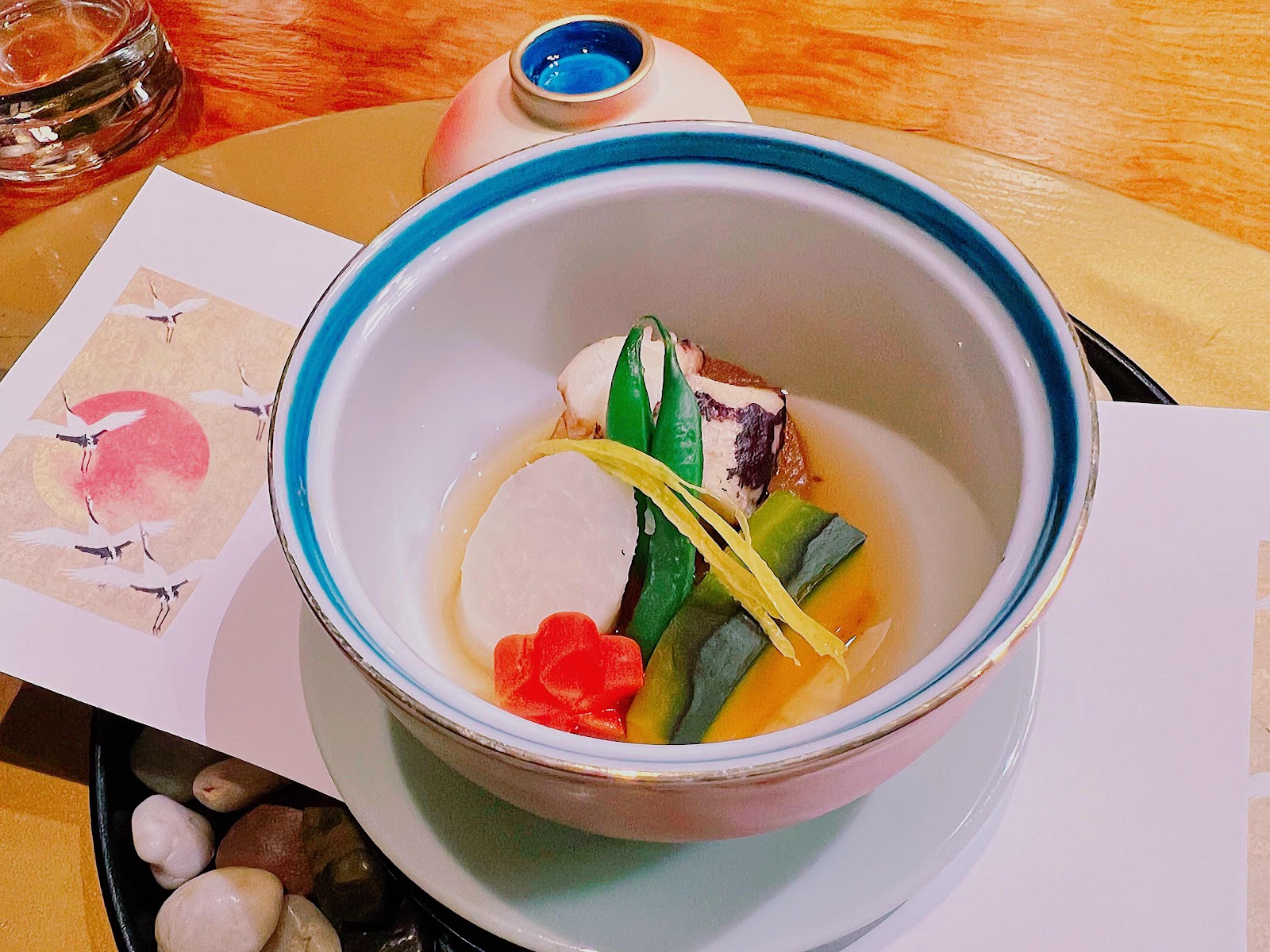
The Spice Girl’s song, When Two Becomes One, is what comes to mind when I think of the taki-awase course. The dish begins with ingredients being stewed separately – in this case, cubes of octopus, vegetables, squash, and daikon – and are then steam together to blend the flavours and aromas without causing the ingredients to become overcooked. After simmering for four hours, the octopus was so tender that if our server didn’t tell us what the protein was, I would have thought we were eating brisket.

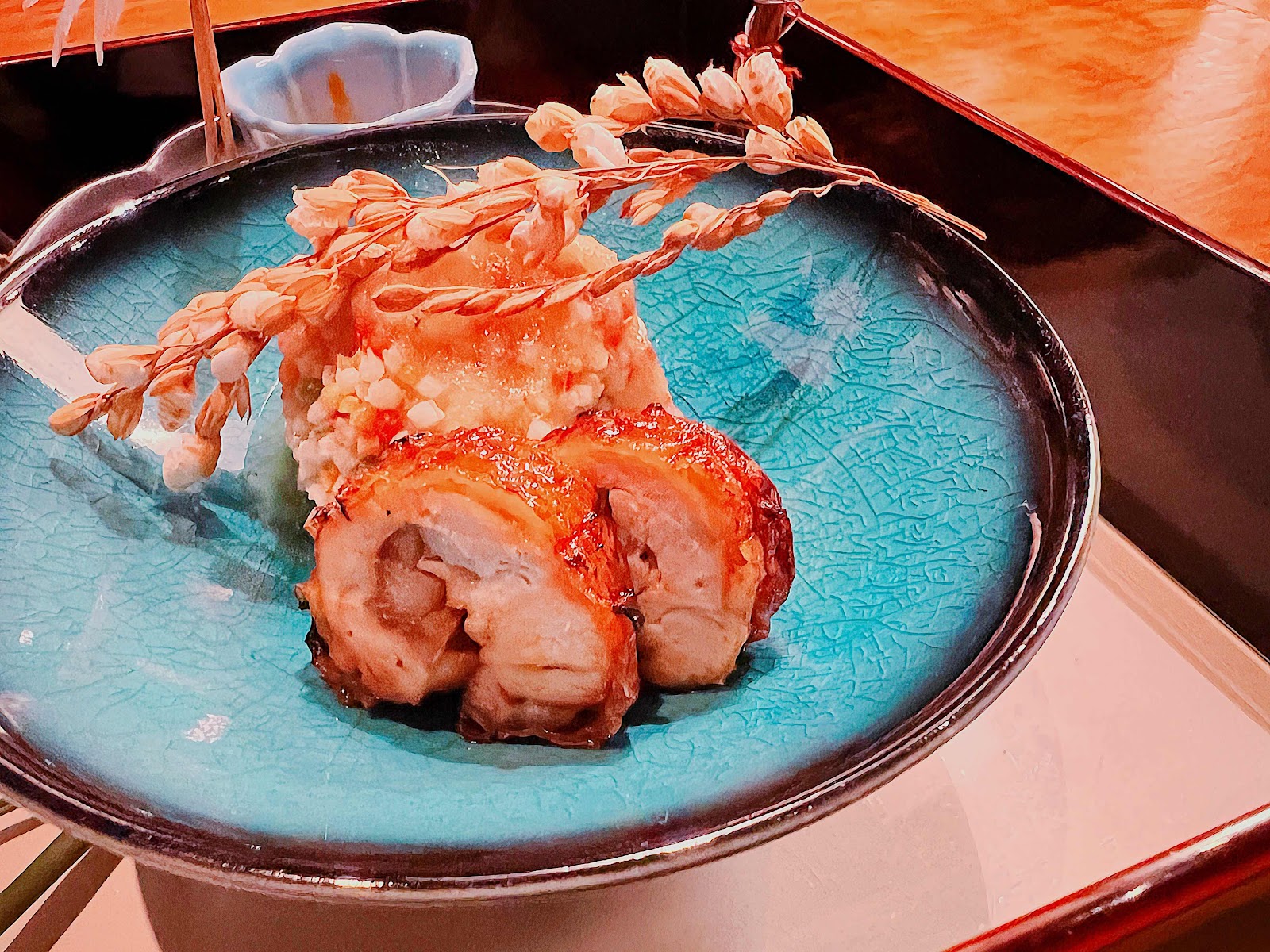
Following the softer steamed dish was the shii-zakana (signature course), which provided a textural contrast with different crispy elements:

  • Medallions of the most incredible chicken teriyaki encapsulating a soft walnut and wrapped in a thin crispy skin. I could munch on rounds of these in lieu of chicken wings.
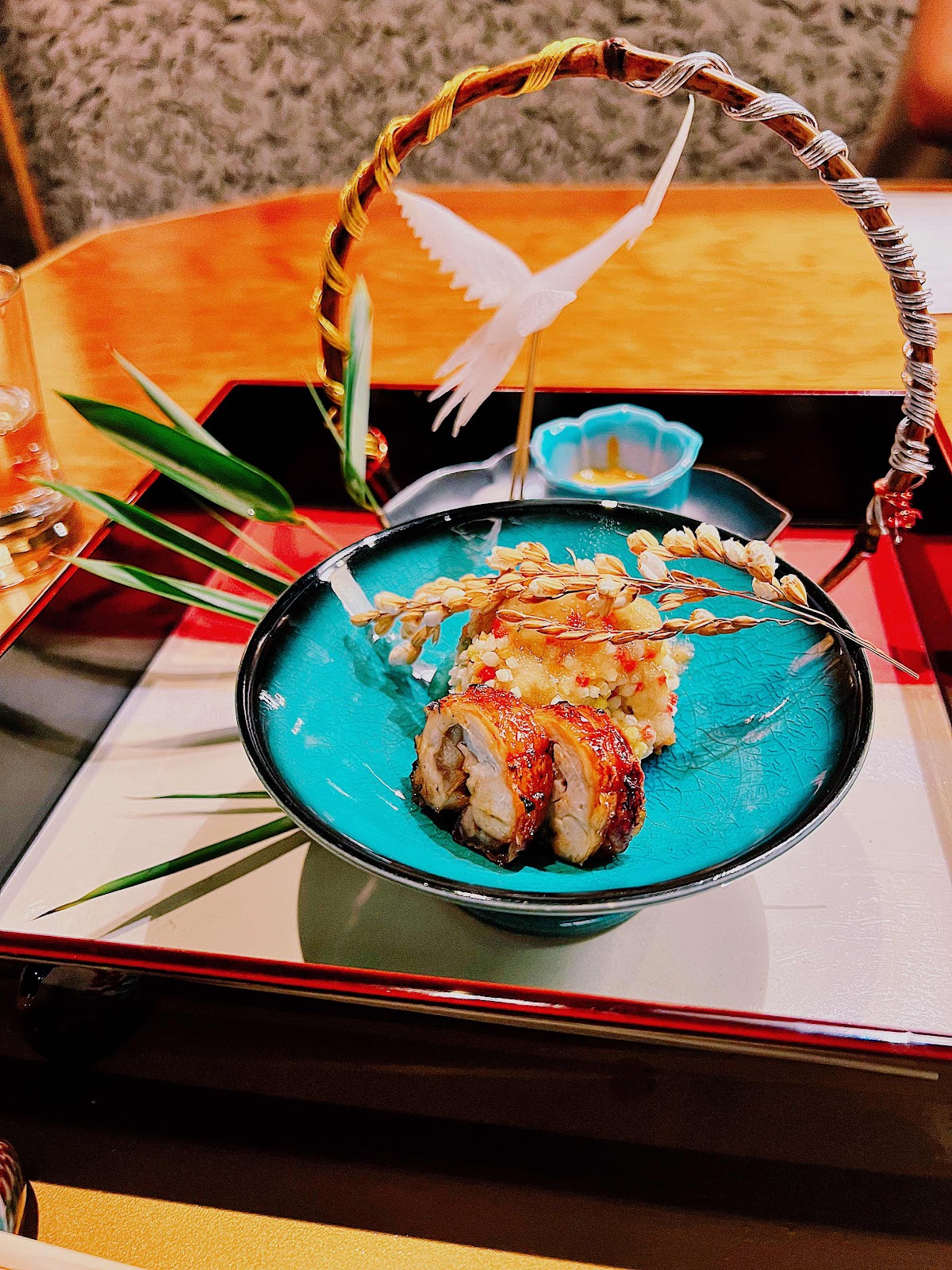
  • A ball of flavourful mashed Japanese potatoes filled with wagyu beef cubes and rolled into crispy rice grains creating something that rivals arancini with its crunchy and soft elements. Of course, in this case, instead of the traditional ground beef and peas, it’s filled with rich wagyu. Oh boy.
  • Even the garnish of popped wheat was edible; a bit fibrous when I took a bite of the entire stalk, but once we started picking out the individual grains from the husk, became almost like a nutty popcorn.

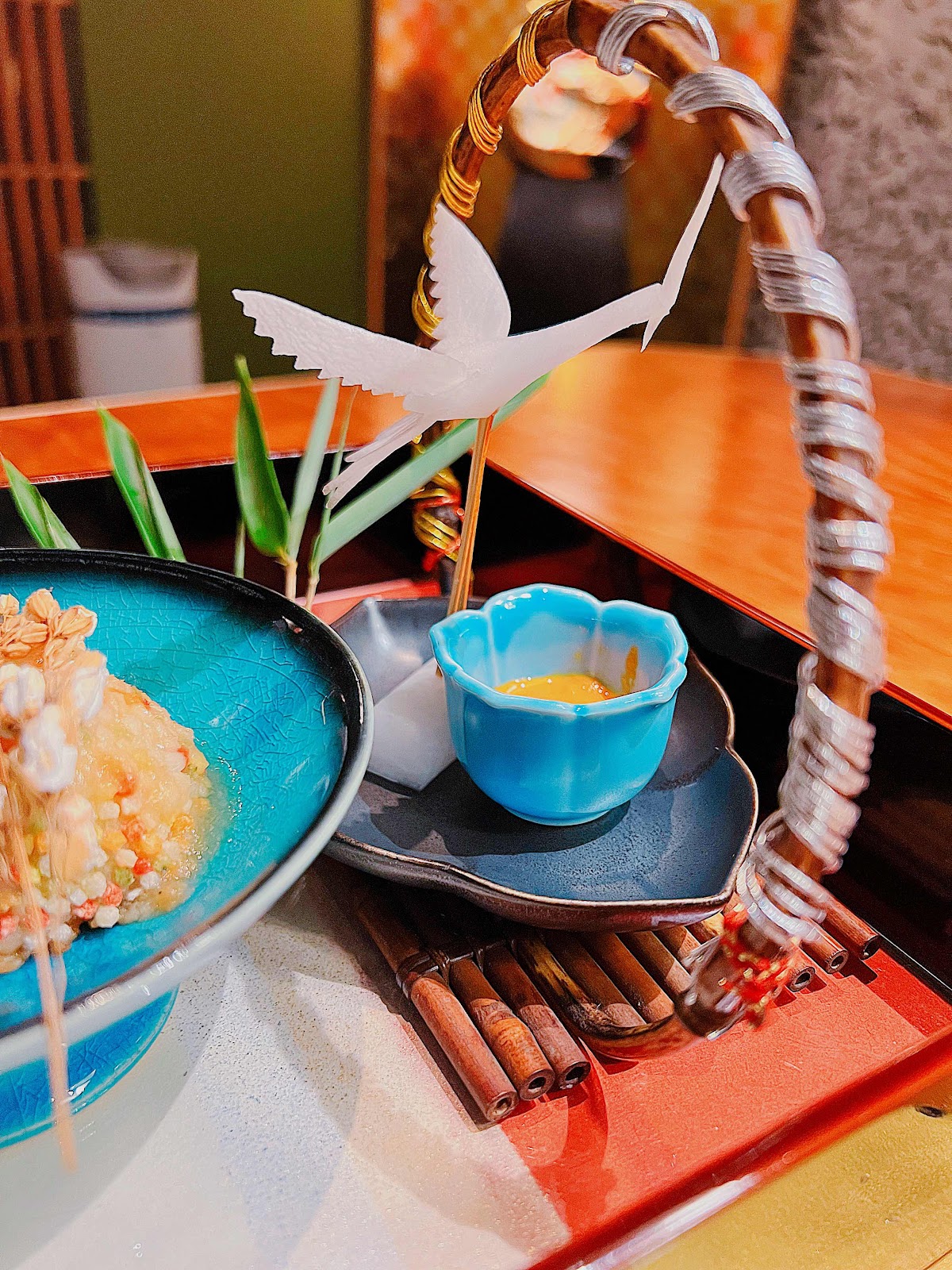
Guilt washed over me as I took my first bite of Chef Hashimoto’s hand carved radish crane… it must have taken so much time to carve its delicate neck and legs! It was the last thing consumed so that I could appreciate its beauty before finally dipping it into the carrot sauce and devouring the refreshing décor.

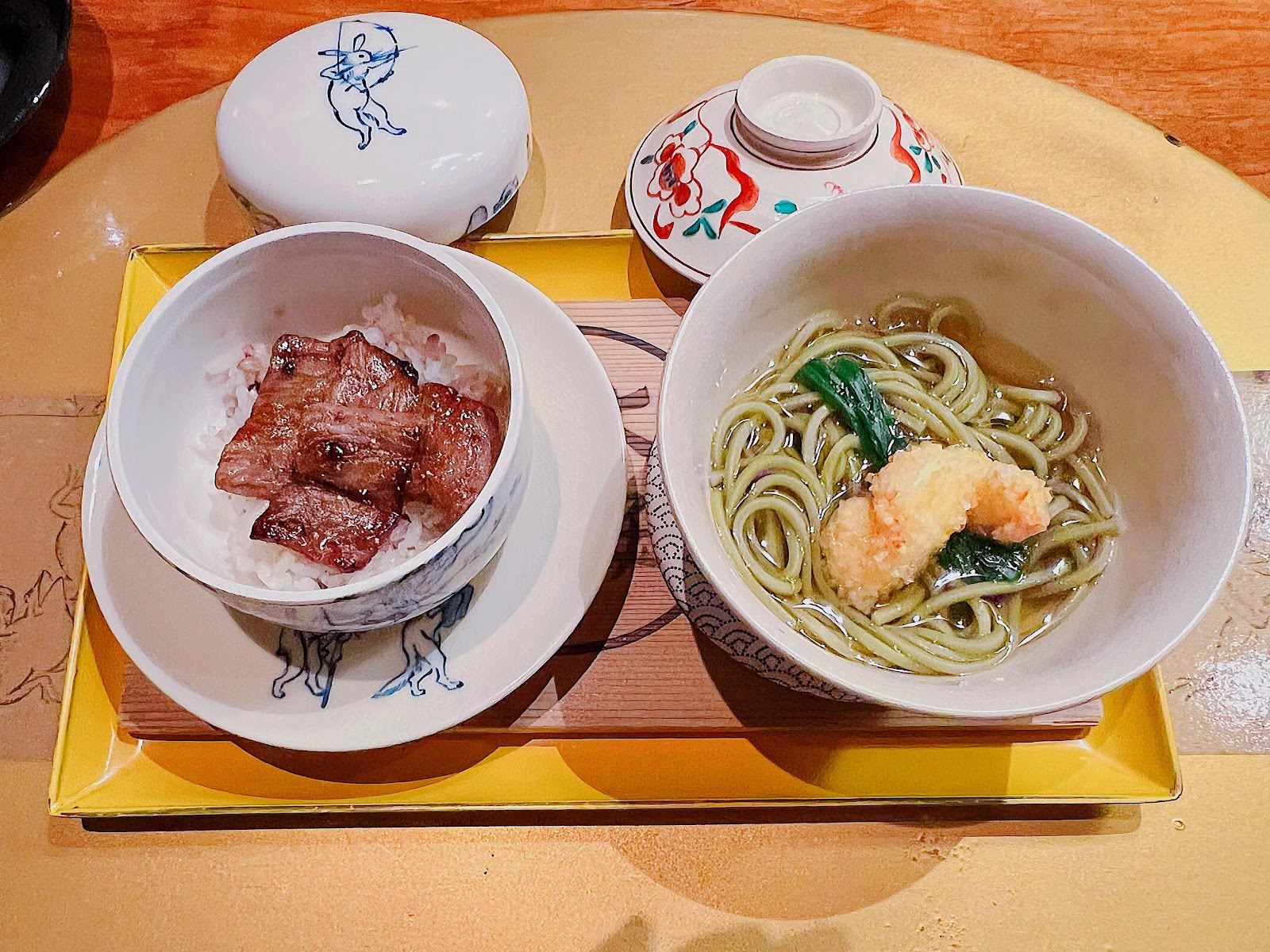
The last savoury course brought a bowl of sticky rice topped with slices of A5 Hyogo wagyu, the prized beef from the Kobe region. While it was delicious, I do wish the beef was left thicker and cut into cubes so that more of the fatty rich flavours would be locked in and flow onto the tongue.

A bowl of noodles and soup is always a delight. In this case, a cha (tea) soba served in a fragrant dashi broth that was good to the last drop. What a lovely way to end and cleanse the palette before dessert.

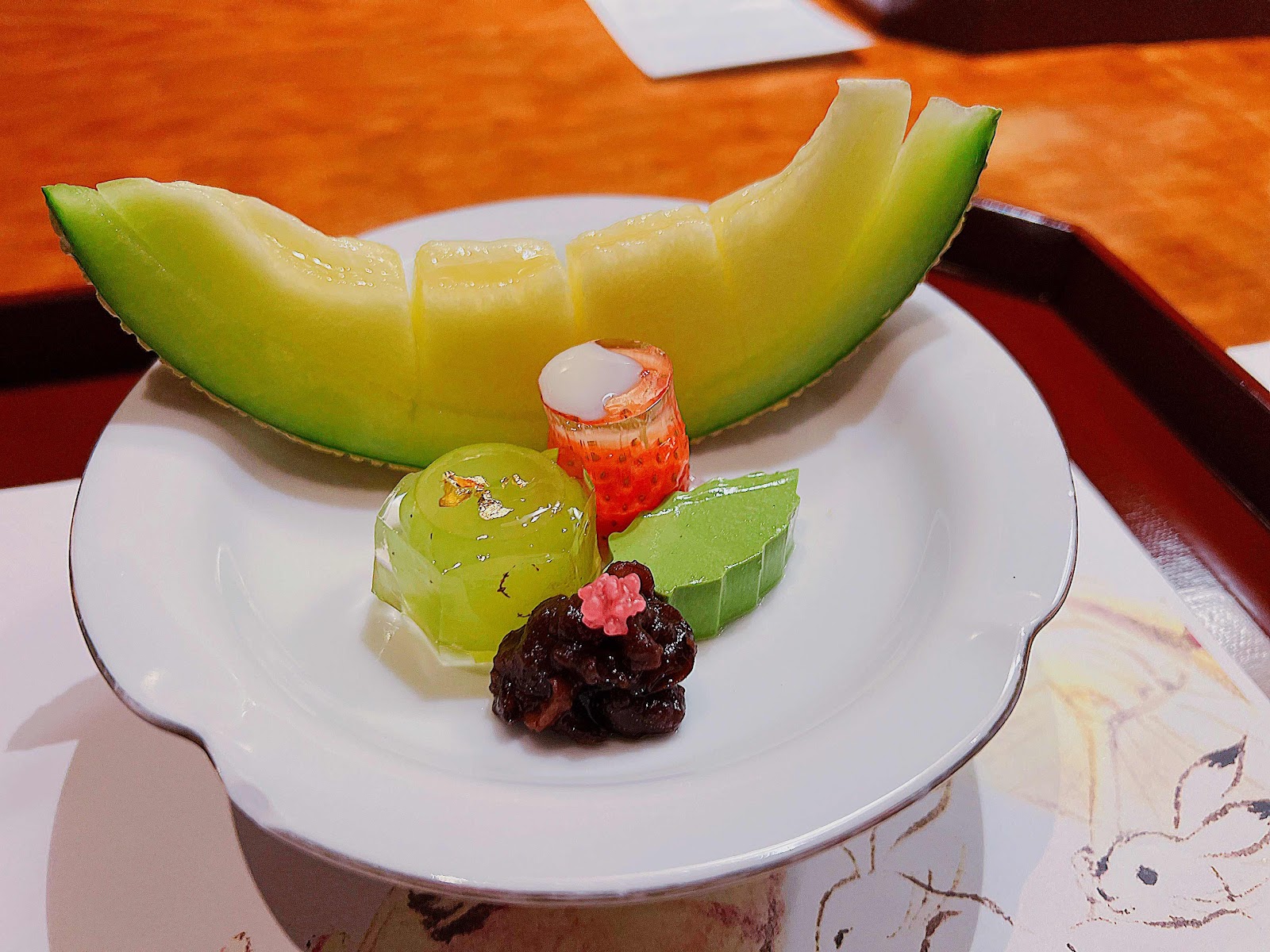
Like many Japanese desserts, the mizu-mono was a fruit plate prominently featuring the expensive Shizuoka musk melon. A sizeable melon is upwards of $200 a fruit and commands the premium as supposedly they are raised to only have one melon per plant to ensure all the flavours are concentrated into one fruit and there being less of a chance of the melon having blemishes.

Indeed, every time I’ve had a slice it’s the sweetest melon ever and tastes like a cross between cantaloupe and honeydew. What also makes it different is the texture: when you have a normal melon it tends to be very soft and sweet in the centre, then gets hard and flavourless as you approach the find. The musk melon tends to have a more uniform sweetness and tenderness throughout.

It’s strange when I’m excited to try fruit, at Hashimoto they also provided a white strawberry encapsulated in a light jelly and topped with condensed milk. Truthfully, it just tasted like a lighter Ontario strawberry that you can purchase at a farmer’s market when it’s in season… I don’t think I would pay the ~$40 for a pint. It was my first experience having a shine muscat, which was like a sweeter and juicier globe grape without seeds. Set in gelatin and adorned with a gold leaf it’s crazy to think that a bunch of these grapes can be upwards of $100.

Aside from the fruit, we were treated to a leaf of uber-rich matcha pudding and a dollop of sweet azuki beans topped with a crispy candy. My recommendation is that Chef Hashimoto switches out the rock sugar with pop rocks to really give the diners a surprise.

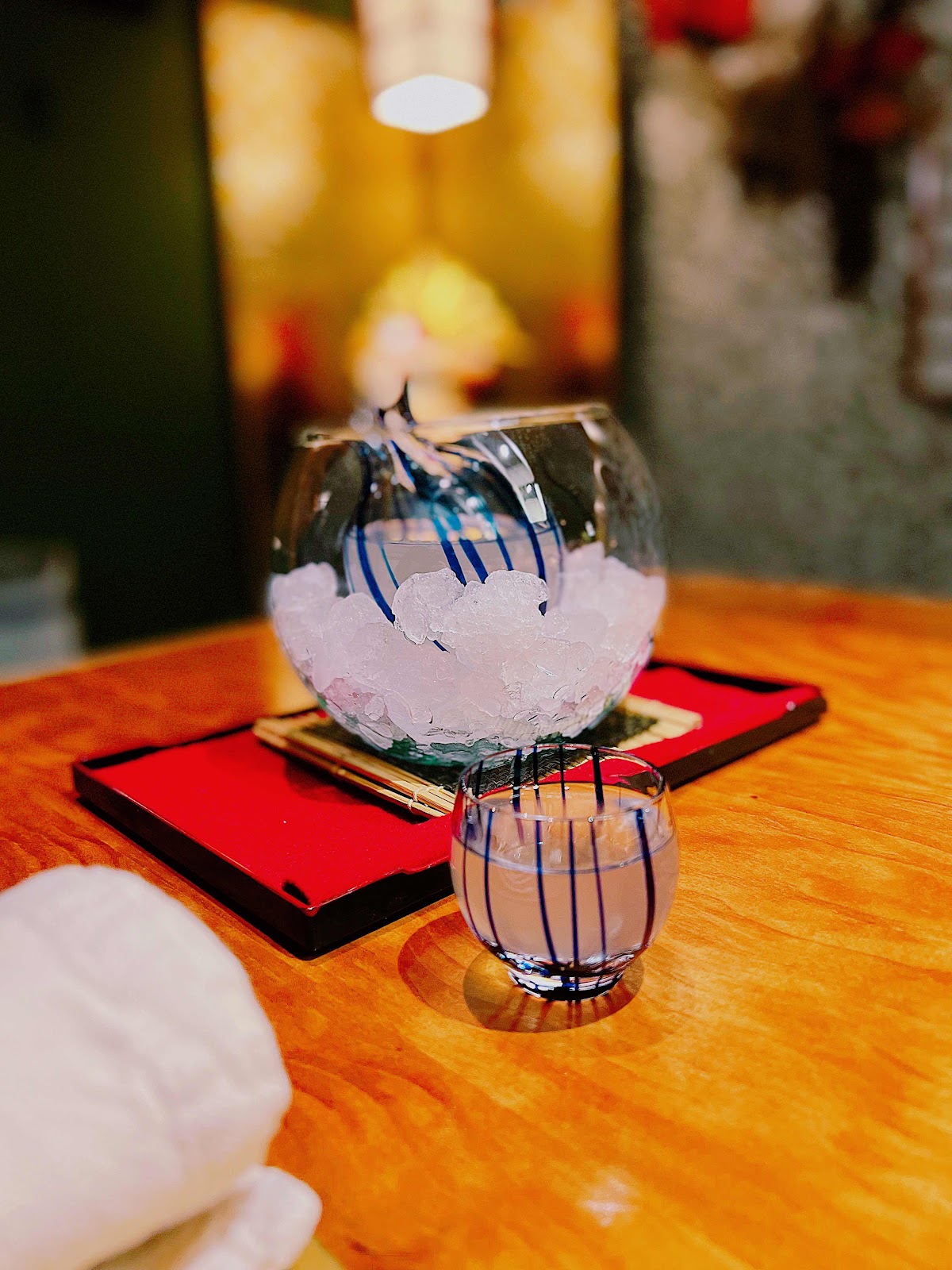
With an extensive sake menu, if you’re not familiar with the Japanese spirit, they have a “sommelier” to help you choose one based on your preferences for other alcohol. Letting her know that we like a dry crisp wine, she recommended the Okunomatsu Junmai Ginjo Genshu Arabashiri that was offered in a half bottle on weekends ($55), which does have a less sweet finish.

For those who are abstaining from alcohol, they also offer pots of fragrant tea ($9 a person) or water served from a kimono clad Swell bottle ($7 a person).

Incredible surroundings and beautiful unique dishes aside, what makes dining at Kaiseki Yu-Zen Hashimoto an unforgettable experience is their service. With only three tables nightly, we were in good hands – just like in Japan, the hospitality rises to another level.

It evens ends warmly with our server offering to take a picture of us, which they email to us later that evening along with pictures of the dishes sampled. It’s a simple and sweet gesture that sets the restaurant apart, from the moment you enter and after you return home, dining at Kaiseki Yu-Zen Hashimoto is a true sensory experience. 

Overall mark - 8 out of 10


How To Find Them
 Location: Toronto, Canada
 Address: 6 Garamond Court


Follow me on twitter to chat, be notified about new posts and more - https://twitter.com/GastroWorldBlog
____________________________
Gastro World's Grading System

  • Anything under 5 - I really disliked and will never go back
  • 6 - decent restaurant but I likely won't return
  • 7 - decent restaurant and I will likely return
  • 8 - great restaurant that I'd be happy to recommend
  • 9 - fantastic restaurant that I would love to visit regularly and highly recommend
  • 10 - absolute perfection!


Is That It? I Want More!

Other Gastro World posts similar to this:


Konjiki Ramen (Toronto)


There’s no shortage of ramen restaurants in Toronto, but Konjiki Ramen is the first international eatery that arrives with a Michelin status. It first started out as a Bib Gourmand pick, essentially being certified as a good deal for the price, but in 2019 Chef Atsushi Yamamoto’s Tokyo location, Konjiki Hototogisu, was finally awarded a much sought after star.

So much of Japan cuisine showcases ingredients prepared in a delicate form to preserve its natural flavours. Ramen is where things start to deviate as rich stocks are combined with a host of other ingredients to create a bowl bursting with flavours. Chef Yamamoto goes one step further adding even more enhancements (lobster, wagyu, and even truffle) to create really luxurious bowls.

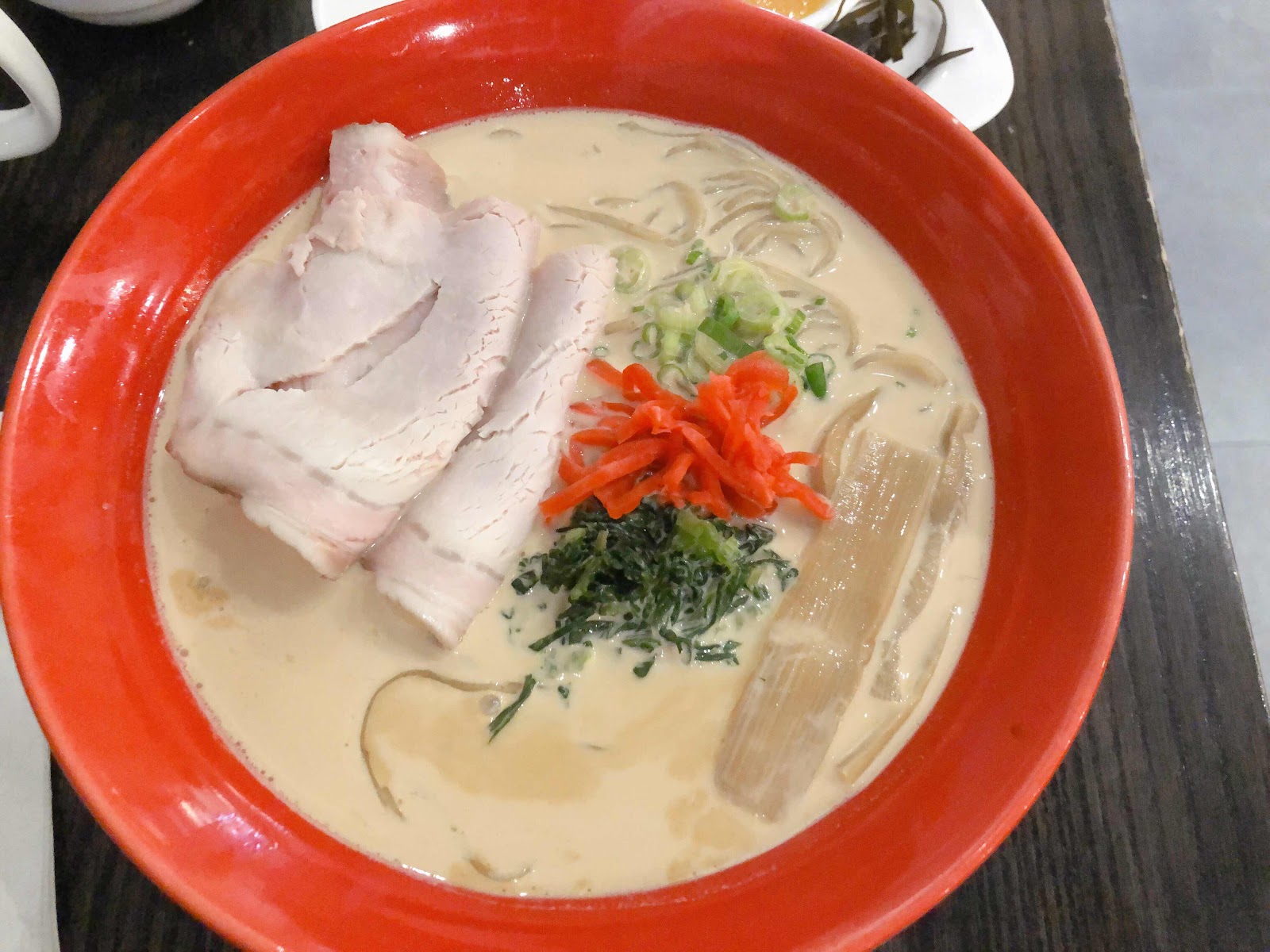
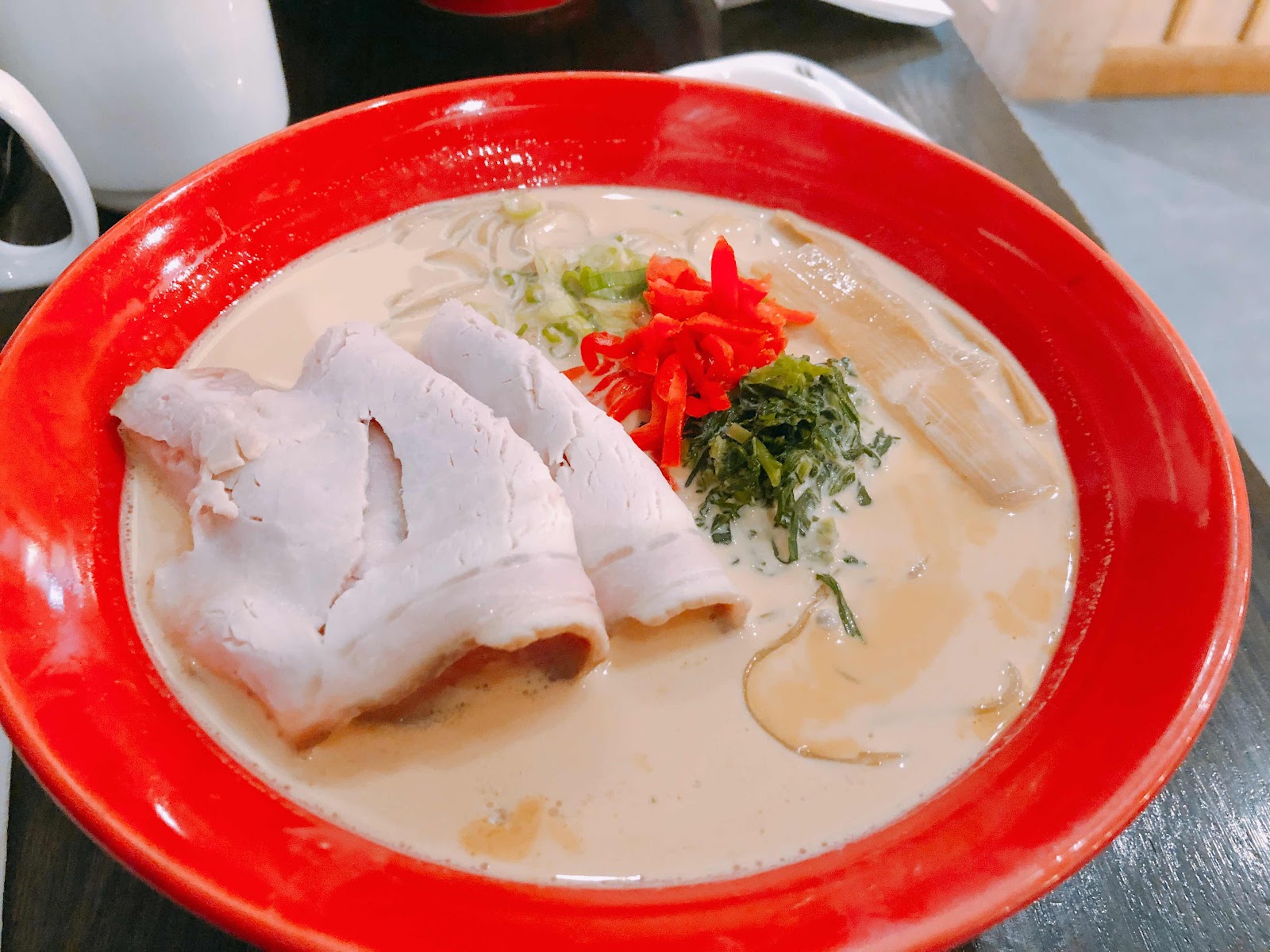
One spoon of their tonkotsu ($13 at North York and $14 downtown) broth and you’ll taste the difference. Their menu explains that it’s made with vast amounts of bones, skins, and other portions of the pig cooked at extremely high temperatures for a long time … the entire process taking two days.


The first sip of the broth blew me away, it has this deep richness that pulls you in and finishes with an almost earthy twist. Of course, it’s also immensely creamy, to the point I’m beginning to think that there must be dairy in it. If there was ever a cream of pork soup, Konjiki’s would make the list.

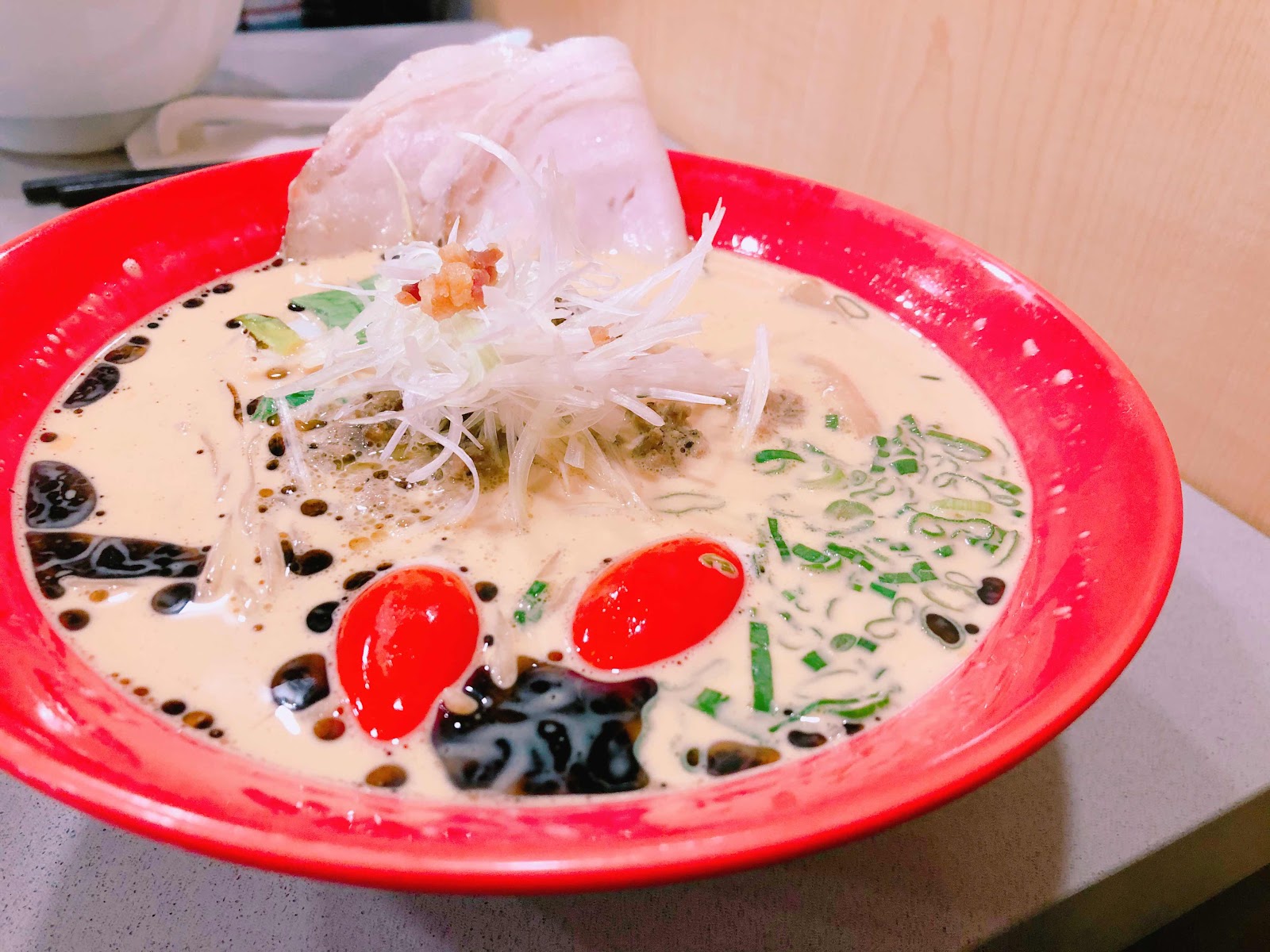
There’s even a smoky black ($14) version of the tonkotsu taking it one step further adding roasted garlic oil, and smoked cherry tomatoes and ground pork into the mix. Indeed, there’s a smokiness to it, but not to the point that you think you’re dining in the Southern USA, it still tastes like ramen.


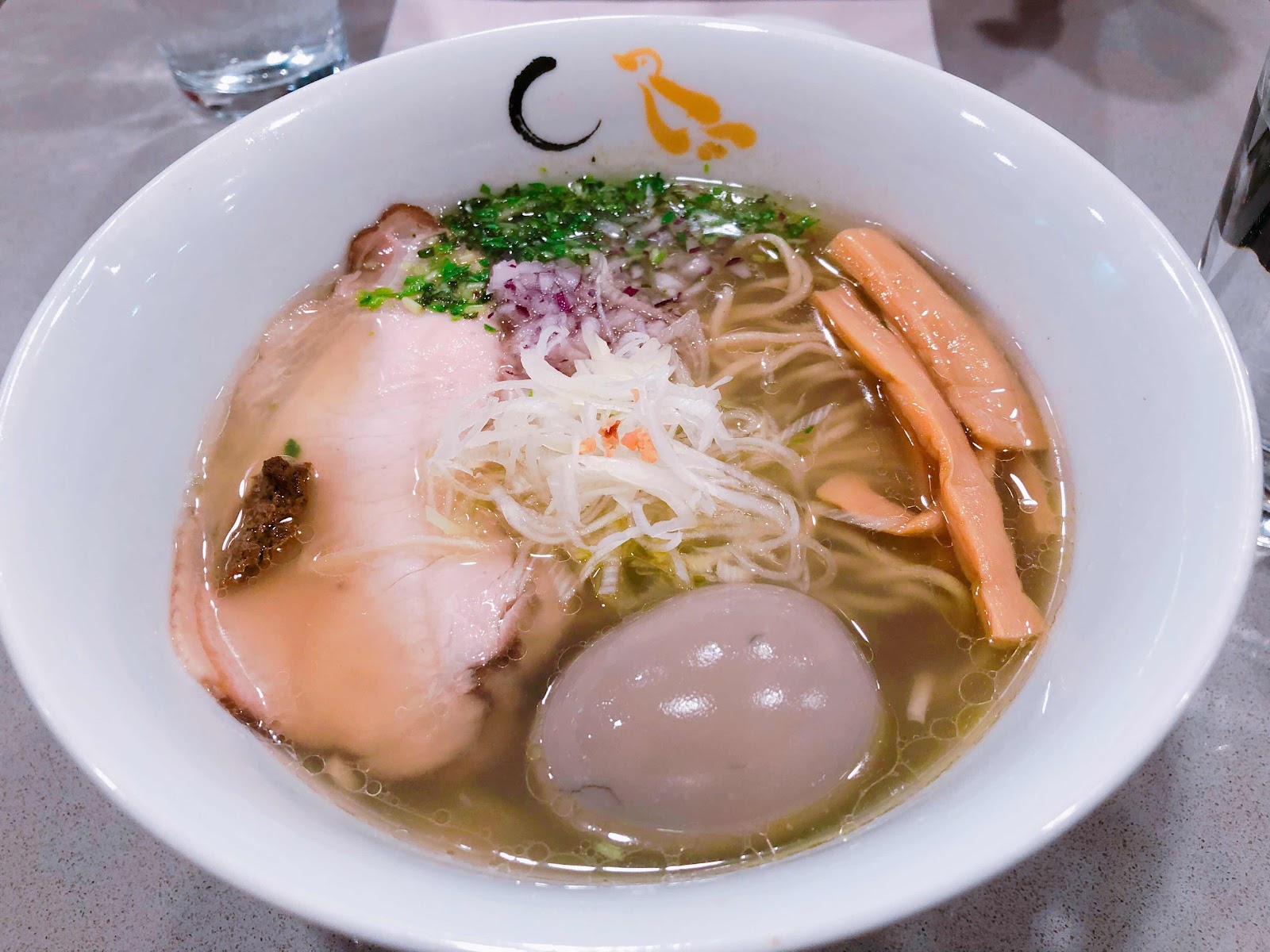
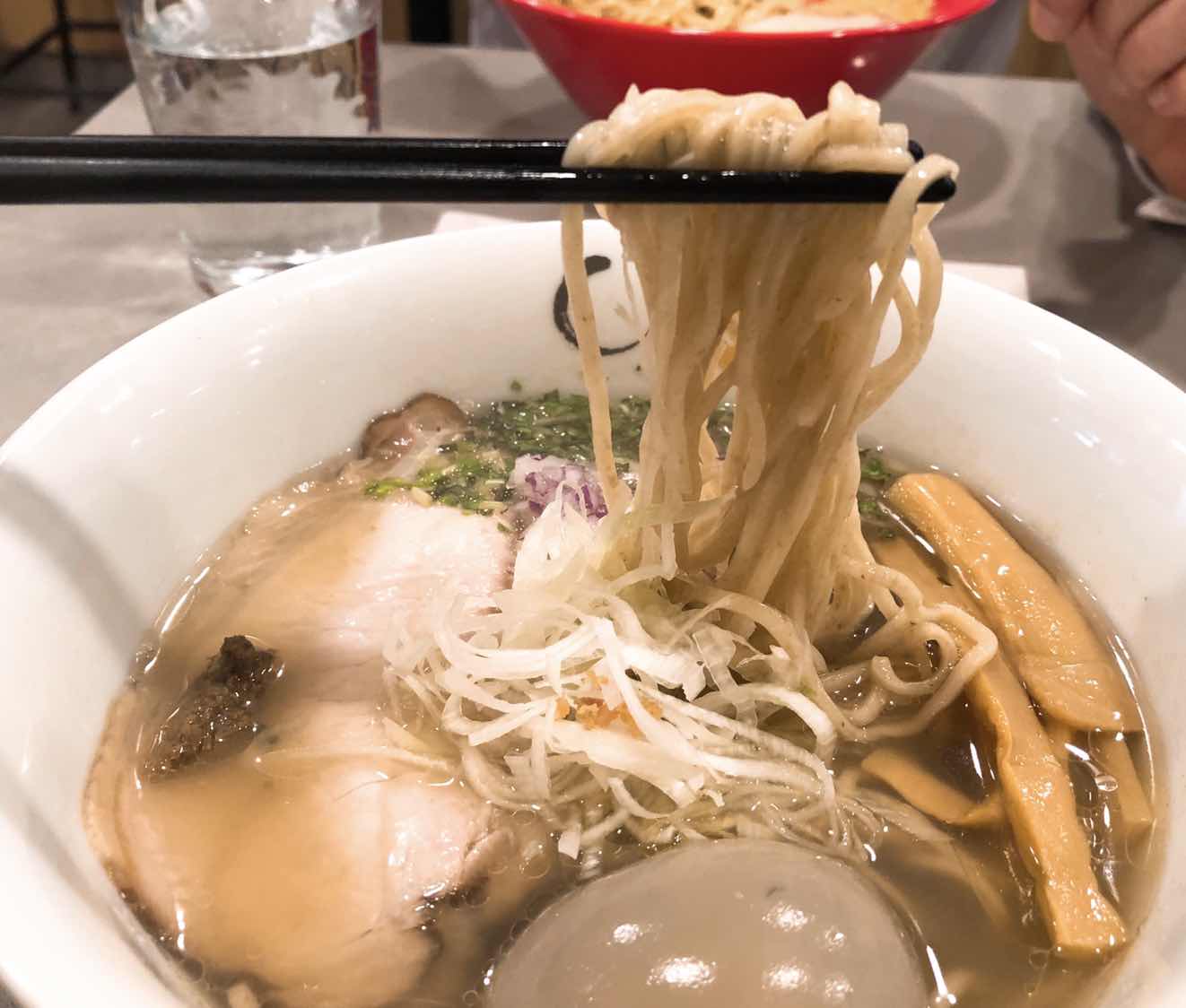
Meanwhile, their shio clam broth ($14) ramen is on the other side of the spectrum where pork is combined with clams and chicken to create a clearer base. There is a lightness to the soup, but still an umami essence throughout the broth thanks to the porcini paste and white truffle oil. Even so, these stronger fungi flavours show restraint so that it’s not necessarily the first thing you taste. The bowl is interestingly paired with chopped arugula, basil, red onions, and pea shoot stems to give it a really fresh element as well.


The clam broth garnishes were better chosen than the tonkotsu, which include the traditional scallion, pickled vegetables, and braised bamboo shoot. But, then the regular tonkotsu includes pickled ginger and the smoky version some smoked cherry tomatoes that were both so overpowering that I had to pick them out.

Add a red wine onsen egg ($1.50) to really finish the experience. It’s left whole and the yolk cooked through but still slightly fluid. As you bite into it, the slightly warm molten centre covers the tongue.

In the end, all the bowls were flavourful but not salty, rich but not oily. Konjiki’s noodles are also what you want with ramen, there’s no choice, all arriving fairly thick so they retain a lovely chewiness. Just the way I like it.


Their chashu (sliced pork) is the only thing that makes me pause. It’s certainly tender from being sous vide, but paired with the clam broth seems to have a strong pork aroma that’s not the greatest. I do like the peppercorn rub along the edges, which give it some extra flavour. Perhaps, a bit more of the spice would help to neutralize the porky aroma.

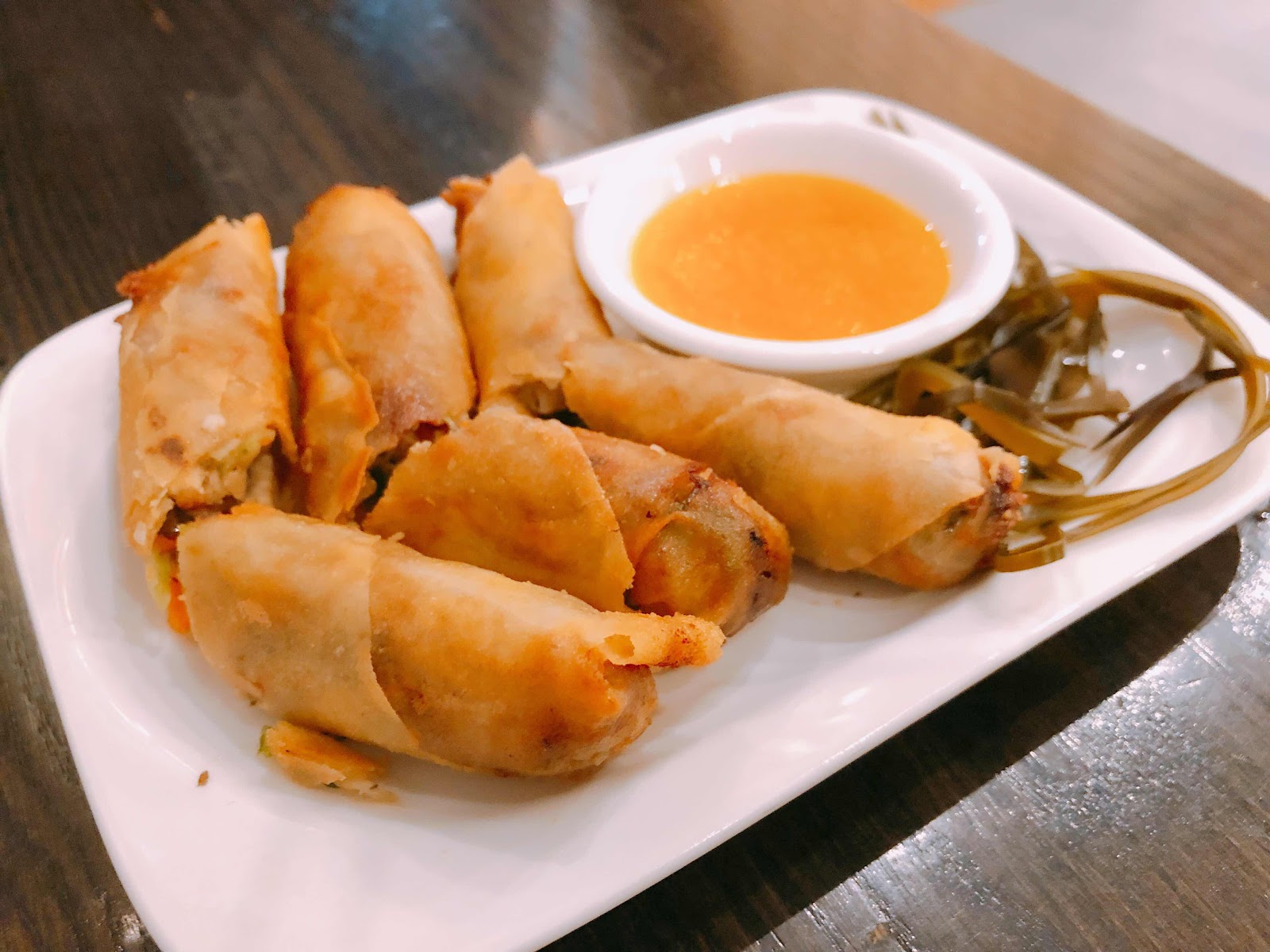
With so much protein, their vegetable spring rolls ($5.50) is a nice way to start the meal. They are the best meatless spring rolls I’ve tasted - the filling made from julienned tofu, bamboo shoot, celery and mushroom creates a lovely combination. Although they are not overly large, the wrapper is kept thin so the vegetables flavours are front and centre. It’s paired with a mango sauce that I can’t say I love, but is a nice change from the typical sweet Thai that’s so thick and sugary.


With every visit to Konjiki, there’s a new taste to experience. Alas, I know I’ll have to eventually return during the week as Mondays and Tuesdays are when their downtown location has a special wagyu option and Wednesday a lobster bowl in North York. With their regular menu offering already such powerful flavours, just how much more intense can it get?

Overall mark - 8 out of 10


How To Find Them
 Location: Toronto, Canada
 Address: 5051 Yonge Street and 41 Elm Street

Follow me on twitter to chat, be notified about new posts and more - https://twitter.com/GastroWorldBlog
____________________________
Gastro World's Grading System

  • Anything under 5 - I really disliked and will never go back
  • 6 - decent restaurant but I likely won't return
  • 7 - decent restaurant and I will likely return
  • 8 - great restaurant that I'd be happy to recommend
  • 9 - fantastic restaurant that I would love to visit regularly and highly recommend
  • 10 - absolute perfection!


Is That It? I Want More!

Other Gastro World posts similar to this: